Otto Zimmermann · 2 October 2026
How Student-Led Quantum Experiments Are Quietly Shaping Sustainable Energy Strategies Across Eastern Europe
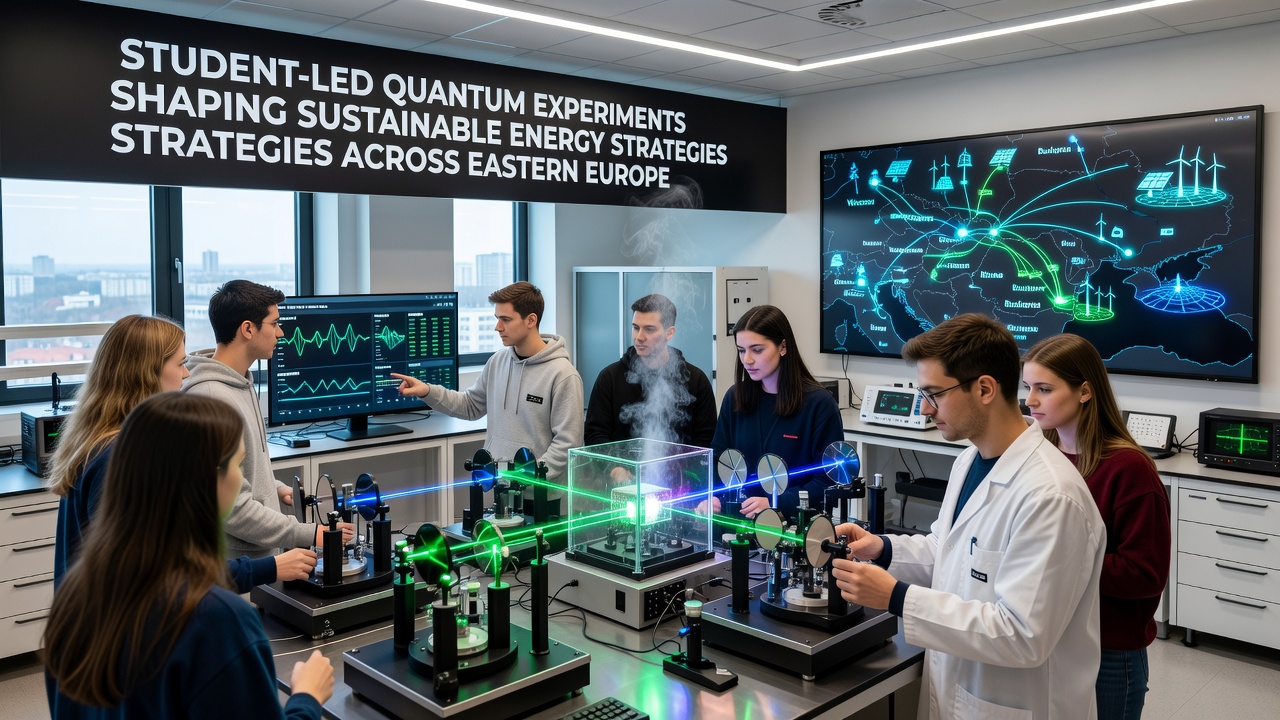
Student teams across Eastern Europe have begun running quantum experiments that feed directly into regional energy planning, and the connections between these projects and policy decisions have grown steadily since 2023. Universities in Poland, the Czech Republic, Hungary, and Romania now host small groups that test quantum algorithms for material simulation and grid optimization, while government agencies incorporate the resulting datasets into long-term renewable targets.
Regional University Programs Driving Experiments
Programs at institutions such as Charles University in Prague and the University of Warsaw have equipped undergraduate and graduate students with access to quantum simulators and cloud-based processors, which allows them to model photovoltaic materials at the atomic level. These simulations produce efficiency estimates that national energy ministries then compare against classical models, and several ministries have adjusted their 2030 solar installation forecasts after reviewing the student-generated figures. In Hungary, teams at Budapest University of Technology and Economics have focused on quantum approaches to battery electrolyte design, and their preliminary results reached the desks of ministry analysts in early 2025.
Observers note that coordination between these labs occurs through informal networks rather than centralized directives, which keeps the work agile while still aligning with broader EU reporting requirements. Data exchanges happen at quarterly workshops, and one such meeting scheduled for October 2026 will review updated quantum-derived projections for wind integration across the Visegrad Group countries.
Applications to Grid Management and Material Discovery
Quantum algorithms tested by students have shown particular utility in solving the combinatorial problems that arise when planners assign renewable capacity across transmission corridors. Researchers at the Technical University of Cluj-Napoca demonstrated that a hybrid quantum-classical solver reduced computation time for a regional dispatch model by roughly 40 percent compared with conventional methods, and the Romanian transmission operator incorporated the technique into its 2026 planning cycle. Similar work in Sofia has examined quantum sensing protocols for real-time monitoring of high-voltage lines, where student prototypes provided temperature and strain readings that classical sensors had previously missed under certain load conditions.
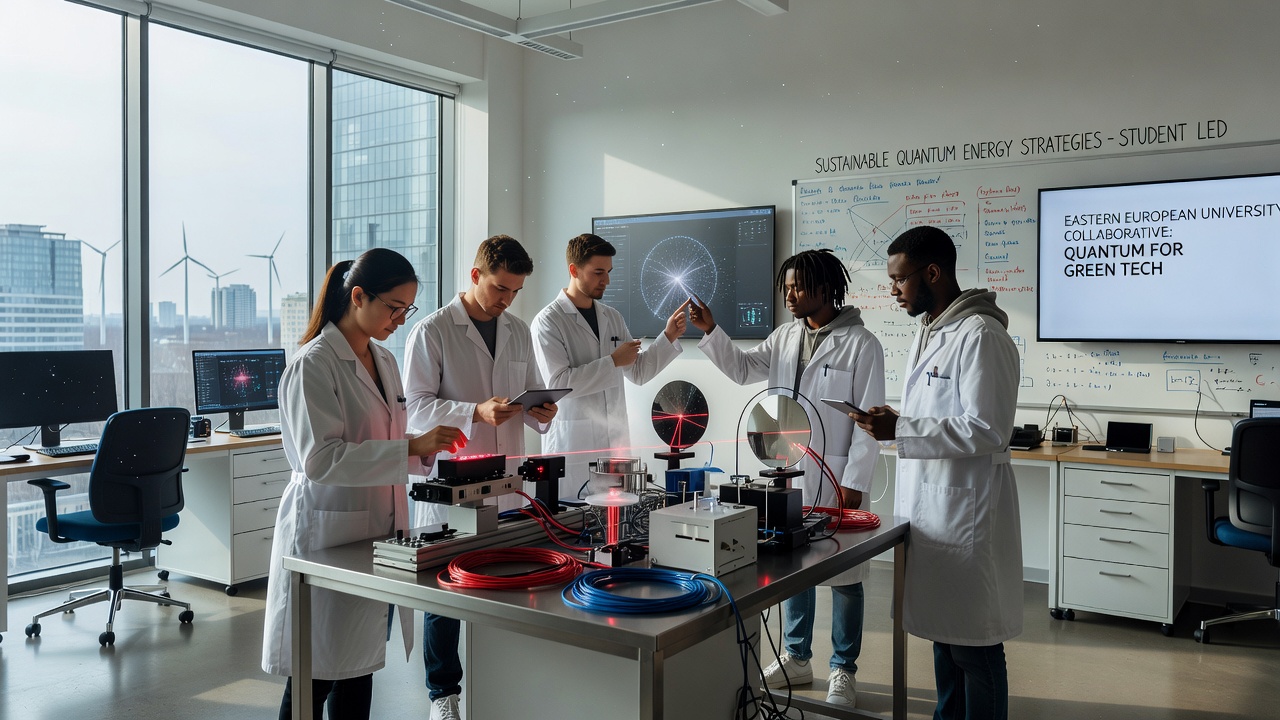
Material discovery efforts have centered on perovskites and other thin-film compounds, and student groups have run variational quantum eigensolver routines on cloud platforms to calculate band gaps more precisely than density-functional theory alone permits. The resulting candidate structures have entered testing pipelines at several national laboratories, and at least two compounds identified through these student calculations entered pilot production lines in 2025. Figures from the European Commission’s Joint Research Centre indicate that Eastern European quantum-related energy publications rose from 28 in 2022 to 67 in 2025, with student-led papers accounting for nearly half of the increase.
Links Between Student Output and National Strategies
Policy documents in the Czech Republic and Poland now reference quantum-enhanced forecasts when setting offshore wind and hydrogen targets, and the Polish Ministry of Climate and Environment has cited student simulations in its annual renewable progress reports. These references remain concise yet indicate that ministries treat the data as one input among several rather than as standalone predictions. International comparisons appear in occasional joint papers, and a 2025 study coordinated by teh International Energy Agency drew on datasets from both Eastern European student groups and laboratories in Canada to benchmark quantum optimization performance across different grid scales.
Funding for the experiments has come from a mix of national research grants and EU structural funds, with universities often supplying the cloud-computing credits that allow students to scale their runs. One collaboration between the University of Bucharest and a Romanian energy utility produced a quantum routing model that the utility tested on a 220 kV subnetwork, and the model identified rerouting options that lowered estimated curtailment by 3.2 percent during peak wind periods.
October 2026 Workshop and Future Data Releases
The upcoming October 2026 workshop in Bratislava will bring together student presenters, ministry representatives, and transmission operators to examine the latest round of quantum grid simulations. Organizers expect participants to release anonymized performance metrics from five additional test networks, and the data will feed into the next round of EU-wide energy system modeling exercises. Earlier workshops have already produced shared benchmark sets that researchers in Australia and the United States have referenced when validating their own quantum energy tools.
Conclusion
Student-led quantum experiments have supplied measurable inputs to sustainable energy planning documents across several Eastern European countries, and the volume of usable outputs continues to grow. The October 2026 workshop will mark another point at which these datasets enter formal review processes, while ongoing university programs maintain the pipeline of new simulations and sensor prototypes. Government agencies treat the results as supplementary evidence that complements classical modeling, and the pattern of incremental integration shows no sign of slowing.