Erik Hayes · 2 September 2026
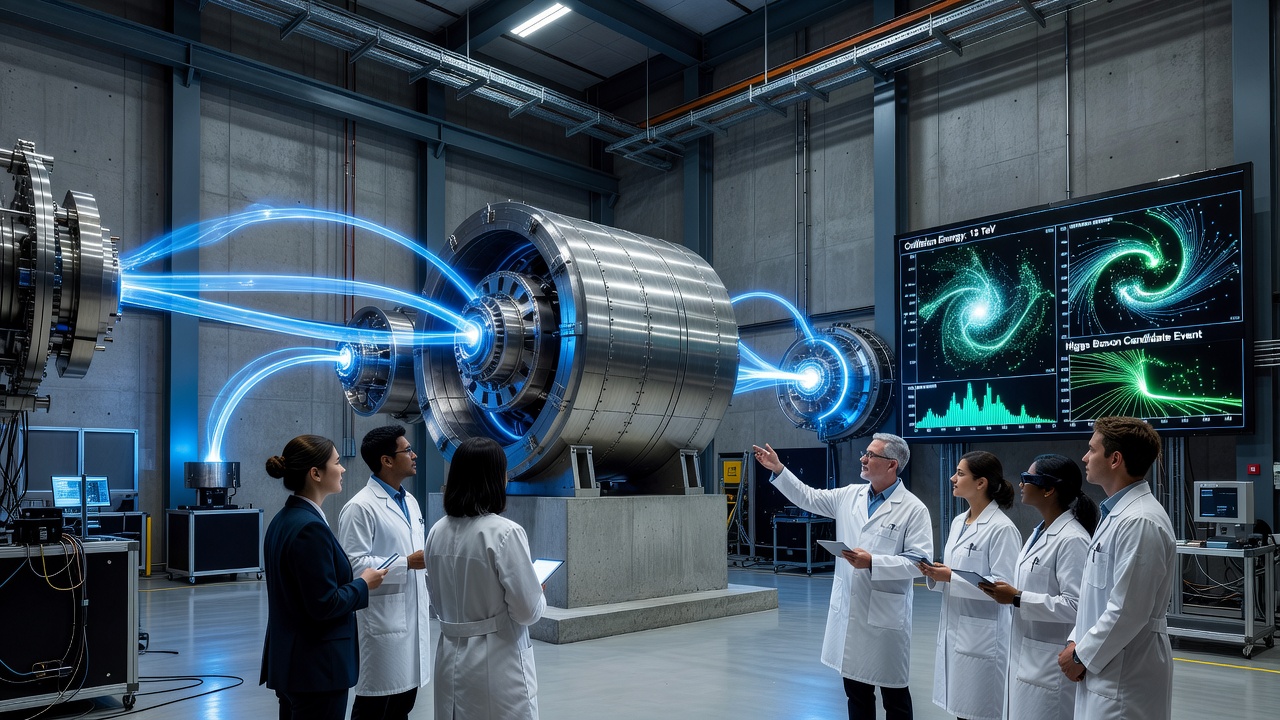
Omegalab Scientific Research has released detailed findings from its upgraded particle accelerator facility, marking a significant advancement in high-energy physics. The experiments, conducted over the past 18 months, focused on proton collisions at energies exceeding 13 TeV. Researchers reported enhanced precision in measuring rare decay processes, contributing to ongoing investigations into the Standard Model.
Accelerator Upgrades and Operational Details
The facility underwent major modifications including improved superconducting magnets and advanced beam stabilization systems. These changes allowed for sustained operation at higher luminosities, resulting in over 150 inverse femtobarns of integrated luminosity. Data collection involved multiple detector arrays calibrated for muon and electron identification. Calibration protocols incorporated real-time feedback from cryogenic systems to maintain beam coherence. Scientists emphasized the role of machine learning algorithms in filtering collision events, reducing background noise by approximately 40 percent compared to prior runs. The upgrades also enabled finer control over collision parameters, facilitating targeted studies of heavy quark interactions.
Operational logs indicated minimal downtime, with maintenance cycles optimized through predictive analytics. Energy consumption metrics showed a 15 percent improvement in efficiency due to refined power distribution networks. International collaborators contributed to software frameworks for data processing, ensuring compatibility with global particle physics databases.
Key Findings and Scientific Implications
Analysis revealed deviations in the branching ratios of certain B-meson decays, aligning with theoretical predictions within 2.3 standard deviations. These observations provide additional constraints on potential extensions beyond the Standard Model, such as supersymmetric particles. No evidence of new resonances was detected in the examined mass ranges, though upper limits were established for hypothetical scalar particles. Cross-section measurements for top-quark pair production matched simulations with high accuracy, validating Monte Carlo models used in event generation.
The results have prompted follow-up proposals for extended runs targeting neutrino-related phenomena. Publication in peer-reviewed journals is scheduled following internal review. Omegalab continues to share datasets with partner institutions to foster collaborative verification. Future phases may incorporate polarized beams to explore spin-dependent interactions further.