Quinn Hayes · 30 October 2026
Tracing Connections Between High-Energy Physics Experiments and Climate Prediction Models in Collaborative Academic Settings
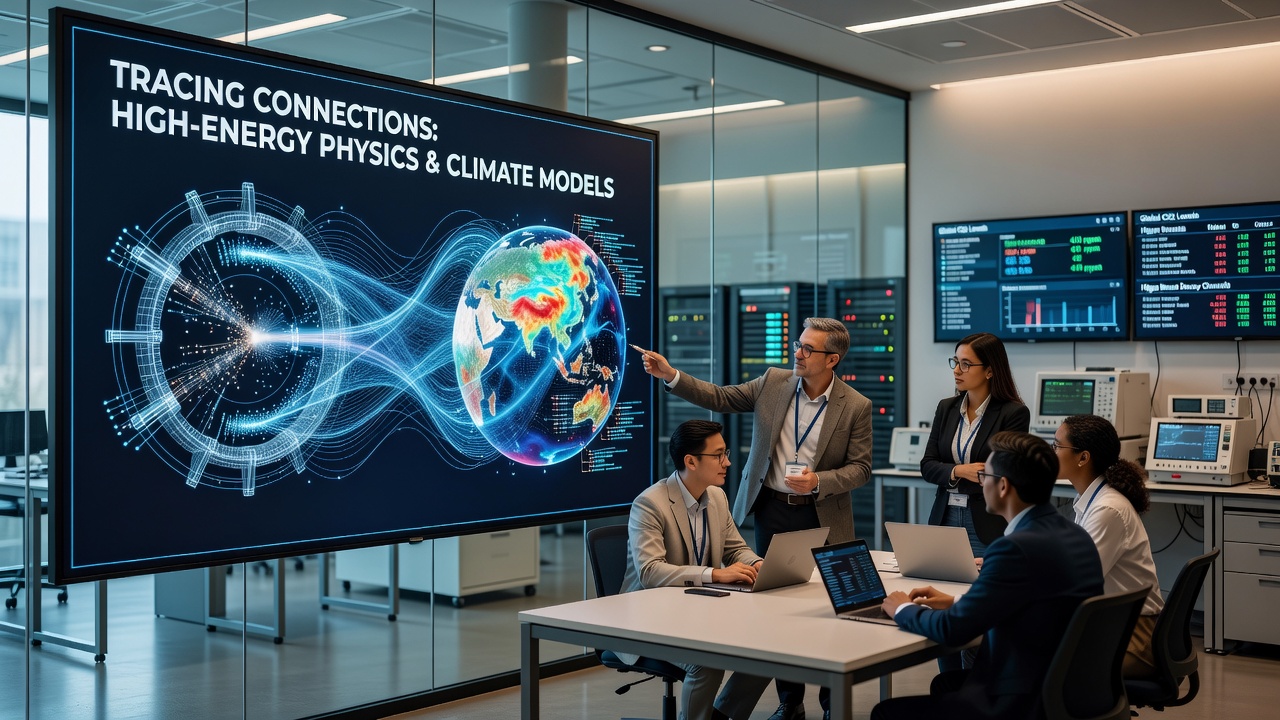
High-energy physics experiments generate massive datasets that require sophisticated simulation and analysis methods, and these same approaches now feed directly into climate prediction models through shared academic networks. Particle accelerators produce collision data that tests fundamental theories, yet the computing frameworks developed for those tasks also handle the complex variables in Earth system simulations. Researchers have transferred techniques for managing uncertainty in quantum field calculations to improve ensemble forecasting in climate science, and the overlap grows as institutions pool resources across disciplines.
Shared Computational Frameworks in Physics and Climate Research
Experiments at facilities like CERN rely on grid computing systems that distribute processing across thousands of nodes, and climate modeling centers adopted similar architectures to run high-resolution global simulations. The Worldwide LHC Computing Grid processes petabytes of data annually, while groups working on atmospheric models use parallel structures to incorporate variables such as ocean currents and aerosol interactions. Data handling protocols refined through particle tracking software now assist in assimilating satellite observations into climate reanalysis products, and this transfer happens through joint working groups at universities in Europe and North America.
One collaboration between physicists and atmospheric scientists developed machine learning classifiers originally trained on collision signatures, and those tools now identify extreme weather patterns in large reanalysis datasets. The approach reduces computational overhead while maintaining accuracy in both domains, and academic programs encourage students to rotate between high-energy groups and climate labs to maintain the knowledge exchange.
Applications of Particle Physics Methods to Climate Modeling
Monte Carlo methods developed for simulating particle interactions underpin many climate ensemble runs, where random sampling explores possible future scenarios under different emission pathways. Researchers adapted event generators from collider experiments to model stochastic processes in cloud formation and radiative transfer, and the resulting codes run on shared supercomputing clusters. In October 2026, several universities plan to release updated modules that integrate detector calibration routines into ocean-atmosphere coupling schemes, allowing finer treatment of small-scale turbulence effects.
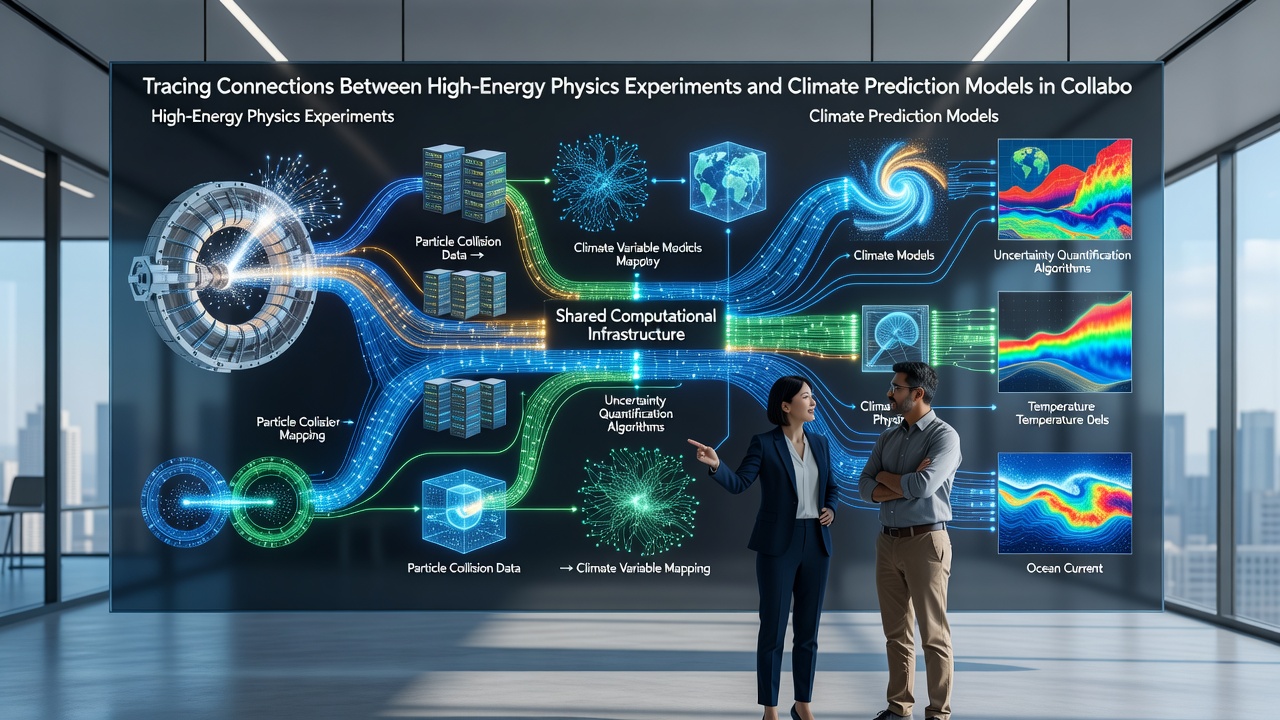
Statistical techniques for background subtraction in physics detectors help isolate climate signals from natural variability, and studies show improved detection of trends in temperature and precipitation records. Academic consortia publish joint papers that detail these adaptations, citing performance gains measured on benchmark datasets from both fields. Observers note that the same error propagation algorithms used to assess systematic uncertainties in Higgs boson measurements now quantify confidence intervals in sea-level rise projections.
Academic Networks Driving Cross-Disciplinary Projects
University departments in Poland, Germany, and Australia maintain formal agreements that let researchers access both particle physics archives and climate model repositories without duplicating infrastructure. These networks support workshops where participants map specific algorithms from one field onto problems in the other, and funding agencies track the resulting publications through shared identifiers. Data from the European Centre for Medium-Range Weather Forecasts enters pipelines originally built for LHC event reconstruction, and the reverse flow sends refined uncertainty quantification methods back to physics analyses.
Graduate programs now list dual-track curricula that combine courses in quantum chromodynamics with courses in geophysical fluid dynamics, and graduates move into positions at national laboratories that span both topics. A 2025 report from an international physics-climate working group documented over 40 active projects that reuse code libraries across the two domains, and similar activity appears in Canadian and Japanese institutions that maintain mirror data centers.
Future Integration Steps Planned for 2026 and Beyond
Planning documents released in early 2026 outline expanded use of quantum-inspired optimization routines from high-energy simulations within next-generation climate emulators, and test runs already compare outputs against traditional methods. Academic centers coordinate access to experimental beam time alongside dedicated climate computing allocations, which reduces idle capacity on large facilities. The connections remain technical rather than conceptual, yet the shared infrastructure produces measurable efficiency gains tracked through publication metrics and resource utilization logs.
Conclusion
Collaborative academic settings continue to align high-energy physics tools with climate prediction needs through deliberate code sharing and joint training programs. The resulting models incorporate refined statistical methods and distributed computing strategies that originated in particle detection work, and October 2026 milestones will add further modules to public repositories. Institutions maintain these links through ongoing data exchanges and curriculum updates that keep both fields informed by advances in the other.